


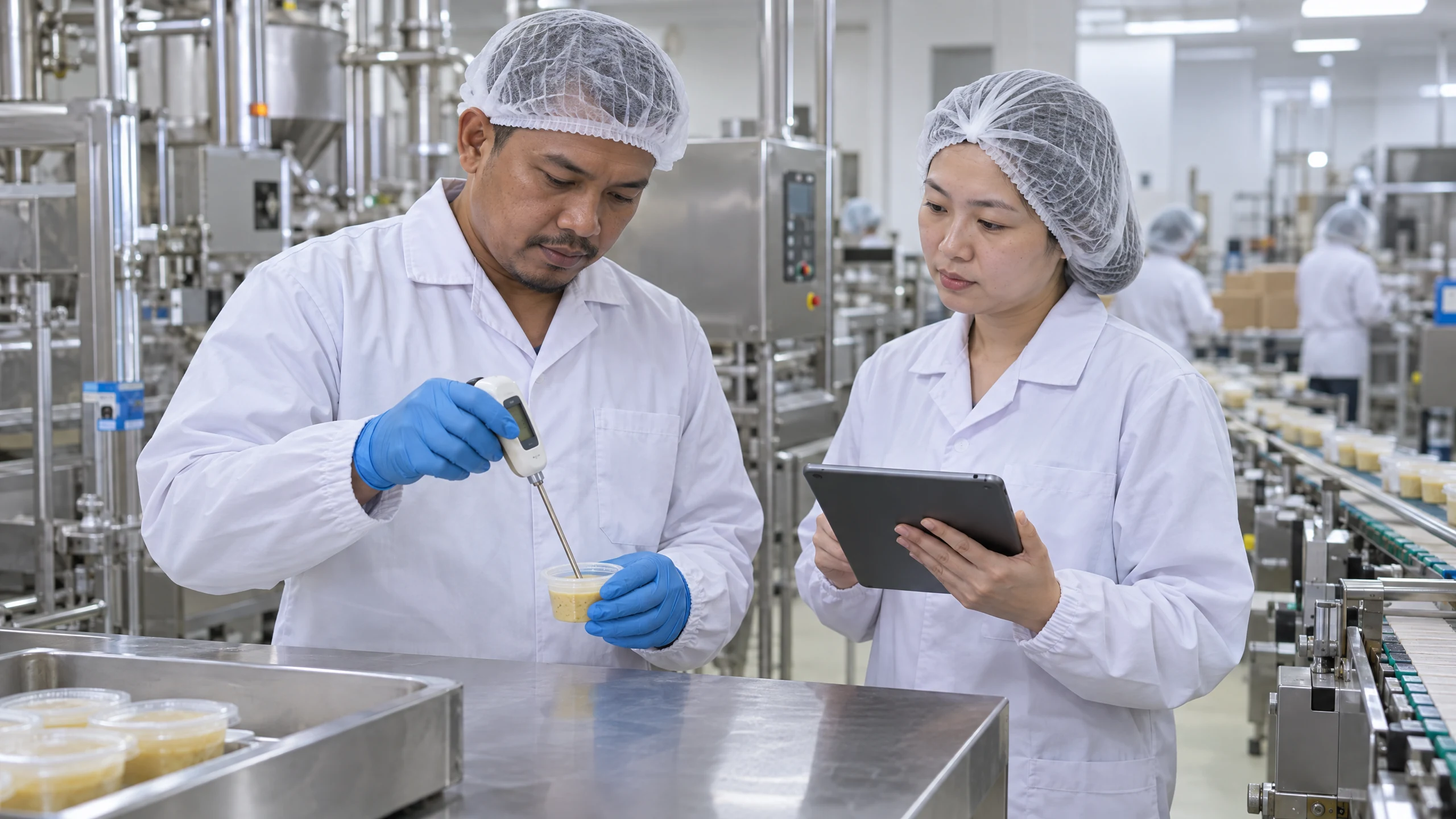
Can AI assist QA and HACCP work in food manufacturing?
AI can help staff prepare drafts, organise approved QA notes, compare records and flag entries for review. It must not set critical limits, replace calibrated monitoring instruments, approve corrective actions or release food. A qualified food-safety team must verify every output against the site's current procedures and source records.
Summaries, comparisons and practice materials can be prepared for review from approved sources.
AI does not create or approve hazards, critical limits, corrective actions or product-release decisions.
Every participant should check the source, mark uncertainty and know when to stop or escalate.
AI training for food manufacturing in Malaysia is most useful when employees practise on real work patterns without handing food-safety authority to a chatbot. QA/QC and production teams may test bounded tasks such as organising deviation notes, comparing a supplier certificate of analysis with an approved specification or drafting a training quiz from a controlled procedure.
Each example below is a training exercise, not a claim that AI has been installed at a named food plant or that AIGreen Plus has delivered a customer result. Use an approved tool and approved or sanitised information. Keep the HACCP plan, monitoring, verification and product decisions under the organisation's established controls.
What should a first AI training exercise prove?
It should show that a participant can use permitted information, produce a bounded draft and check every important detail against its source. For example, when a temperature log contains a missing entry, the employee should identify the gap and follow the approved escalation route. The exercise should never ask AI to invent a reading, select a critical limit or decide whether a batch is safe.
Seven practical AI training exercises for food manufacturers
These are illustrative learning tasks, not food-safety certification, validated controls or completed client projects. Train with synthetic, sanitised or explicitly approved examples, and keep the responsible reviewer in charge.
| Team / workflow | AI practice task | Required human checkpoint |
|---|---|---|
| QA/QC — deviation notes | Turn approved non-conformance notes into a draft list of product, lot, date and recorded observation fields, marking missing information rather than filling it in. | QA checks every field against the original record and determines the investigation and disposition under site procedures. |
| Food safety — temperature records | Compare supplied readings with an already approved example threshold and flag rows that may need a human check. | The authorised person confirms the original measurement, instrument status, applicable limit and required response. AI does not set limits or close a deviation. |
| Document control — SOP changes | Draft a side-by-side change summary from two controlled procedure versions and list sections that appear different. | The document owner checks the versions and approves all wording, effective dates, training and release controls. |
| Receiving — supplier records | Extract lot, date and stated specification fields from an approved supplier document into a draft comparison checklist. | A trained receiving or QA employee verifies the source, approved specification and lot identity before acceptance or escalation. |
| QA — corrective-action trends | Group a permitted set of historical deviation descriptions by recurring terms and show which source records support each proposed group. | QA tests the grouping against original records and does not treat correlation or repeated wording as a proven root cause. |
| Food safety — training materials | Draft a short knowledge check from a current, approved hygiene or HACCP training document. | The competent trainer verifies every answer, avoids changing technical instructions and controls the final training version. |
| Production — shift handover | Prepare a draft summary of approved shift notes that separates completed actions from open food-safety or quality issues. | The supervisor and relevant QA owner confirm unresolved items, responsible persons and escalation before using the summary. |
A five-step, human-reviewed AI training workflow
Choose one bounded task
Name the task owner, intended users, start and end points, permitted inputs and decisions that stay outside the exercise.
Prepare approved practice material
Use current controlled documents and synthetic or sanitised examples unless the organisation has explicitly approved a tool and data flow.
Ask for a limited draft
Specify the source, requested format and rule to mark missing or conflicting information. Tell the tool not to infer a cause, measurement or approval.
Check against the source
Participants compare fields and statements with the original record, record corrections and use the existing escalation process for uncertainty.
Measure, then decide
The process owner reviews quality, time, corrections and procedure adherence before deciding whether to revise, continue or stop the exercise.
HACCP remains a food-safety system, not an AI prompt
HACCP means Hazard Analysis and Critical Control Point. Codex describes it through hazard analysis, critical control point determination, validated critical limits, monitoring, corrective action, validation and verification, and appropriate documentation. The organisation's competent food-safety personnel remain responsible for applying the relevant plan to its products and process.
A generative AI assistant can produce a convincing sentence that is still unsupported or wrong. It should not determine whether a hazard is significant, set or revise a limit, replace a calibrated instrument, decide that monitoring is complete, or release a product. Any proposed output that could affect a food-safety decision must be checked through the site's approved process by the appropriate person.
Malaysia's Ministry of Health Food Safety and Quality Programme describes its role under the Food Act 1983 and subsidiary regulations and explains the separate scope of food hygiene controls and recognition or certification. Requirements depend on the applicable rules and operation. This newsletter does not assert that every food manufacturer must hold HACCP certification or that AI training provides certification.
Codex General Principles of Food Hygiene, including HACCP · Malaysia MOH Food Safety and Quality Programme
Keep records traceable and follow document control
Food-safety and quality records need to remain attributable to their source, time, product or lot, and authorised reviewer under the organisation's procedures. A generated summary should be labelled as a draft where appropriate, preserve references to original records and never silently overwrite the controlled record.
If the tool cannot show where a statement came from, if a source is incomplete, or if two records disagree, the right training outcome is to identify the uncertainty and escalate it. Do not ask staff to accept plausible completion as evidence.
Protect business and personal information during practice
Before using a workplace AI tool, the organisation should decide which records are permitted, where information is processed, who can access it and how outputs are retained. Prefer synthetic or sanitised practice records when live data is not approved. This is especially important when records may include employee, customer or supplier personal information or confidential process details.
Malaysia's AICE is described by AI Malaysia as voluntary and non-binding guidance. The Personal Data Protection Department's notice guidance explains how a data user informs data subjects about personal-data processing; it is not a complete assessment of every AI use. Check applicable requirements with the organisation's privacy owner or adviser.
Malaysia Voluntary AI Code of Ethics (AICE) · Malaysia personal-data protection notice guidance
Check the exact HRD Corp programme separately
If an employer intends to use HRD Corp funding, check the current scheme, employer eligibility, exact training programme registration and application requirements directly with HRD Corp before making a booking or claim assumption. HRD Corp's provider page describes programme registration through e-TRiS. This guide does not claim that this specific AIGreen Plus course is registered, eligible or approved for a grant.
Measure verified learning, not attendance alone
Agree the sample, source records, acceptance checklist and reviewer before the exercise. Count checking and correction effort as part of the task. These are suggested measures, not reported customer outcomes or promised savings.
| Measure | Definition / method | Evidence source | Reviewer |
|---|---|---|---|
| Source accuracy | Check whether required values and statements match the source, and record omissions, unsupported additions and conflicts. | QA review checklist and source-linked sample | QA or food-safety owner |
| Exception recognition | Use a safe training example with a known missing or conflicting entry and see whether the learner flags it instead of guessing. | Controlled exercise answer key and escalation record | Trainer and process owner |
| Total task effort | Compare the same bounded task, including preparation, review and correction; do not count only the AI drafting time. | Comparable manual and exercise time records | Function manager |
| Procedure adherence | Confirm the approved tool and data were used, required review occurred and controlled records were not changed without approval. | Exercise log and applicable document-control record | Quality-system owner |
Plan AI training around a real QA or food-safety task
AIGreen Plus can discuss the team's roles, permitted practice data and intended learning outcome. Confirm the course content, trainer, duration, delivery method, tools and any follow-up in writing. This educational guide is not a completed customer engagement, food-safety certification or guarantee of compliance or operating results.
Explore AI Training for ManufacturingFrequently asked questions.
Direct answers about using AI in Malaysian food-manufacturing QA and HACCP training.
How can AI help a Malaysian food manufacturer?
In a controlled training exercise, AI can help draft summaries, organise approved QA notes, compare specified record fields or prepare a quiz from a current procedure. Each output should remain a draft until the responsible person checks it against source records and site procedures.
Can AI replace a HACCP team or food-safety officer?
No. AI training does not replace the competent people responsible for hazard analysis, monitoring, corrective actions, verification, records or product decisions under the organisation's food-safety system.
Can generative AI set a HACCP critical limit?
No. Critical limits need the appropriate scientific basis and validation under the HACCP plan. An AI tool should not generate, revise or approve a limit.
Can AI review temperature-monitoring records?
It may help sort or flag records for review if the tool and data are approved. Staff must verify the original readings, instrument and applicable procedure. AI is not a monitoring instrument and cannot make the site's safety disposition.
Can AI write a HACCP plan or SOP?
It can produce a draft or change summary from authorised source material, but qualified personnel must confirm the hazards, controls, technical accuracy, site-specific relevance, revision status and approval before any controlled use.
What data should employees use in AI training exercises?
Use synthetic or sanitised information unless the organisation has approved the tool and specific data flow. Avoid entering personal, confidential or commercially sensitive records into unapproved services.
How should QA staff check an AI-generated answer?
Compare every important statement and value with the original approved source, check units and lot identifiers, note omissions or contradictions and escalate uncertainty. Never accept a fluent answer as proof by itself.
Who should attend AI training for food manufacturing?
Choose participants based on the task. A QA or HACCP exercise may include QA/QC, food-safety, production and document-control staff, along with the process owner who will review the work.
Is this specific AI training course automatically HRD Corp claimable?
No such claim is made here. Verify the exact programme registration, employer eligibility and current application conditions directly with HRD Corp before relying on funding. This article does not confirm that an AIGreen Plus course is registered or grant-approved.
How can a factory measure whether the AI training helped?
Use a defined exercise and source-based checklist. Review correctness, missed exceptions, unsupported statements, checking time, corrections and procedure adherence. Compare like-for-like work and do not treat attendance or an illustrative example as proof of savings.
Further reading
These official sources were reviewed on 11 November 2026. They provide food-safety, responsible-AI, privacy and programme-registration context; this newsletter is an educational guide, not legal advice, HACCP certification or a prescribed course standard.
